
Architecture
Overview
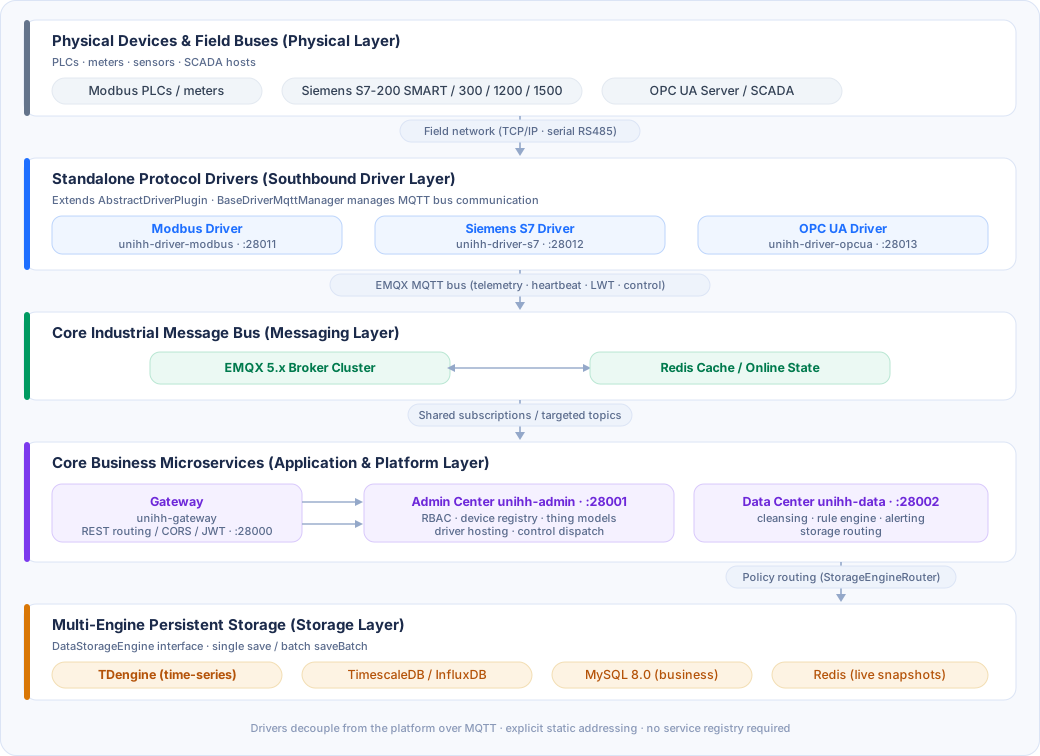
Five layers from top to bottom: physical devices connect through field buses into standalone protocol drivers; all interaction between drivers and core microservices runs over the EMQX message bus; the storage layer routes data by shape through policy routing.
Services
Independent microservice processes
| Module | Type | Default port | Responsibility |
|---|---|---|---|
unihh-gateway | Microservice | 28000 | Single entry point, REST routing, CORS, JWT auth interception |
unihh-admin | Microservice | 28001 | RBAC, device registry, thing models, driver lifecycle, control commands |
unihh-data | Microservice | 28002 | Point normalization, rule computing, alert triggering, storage routing |
unihh-driver-modbus | Driver | 28011 | Modbus TCP/RTU acquisition and register write-back |
unihh-driver-s7 | Driver | 28012 | Siemens S7-200 SMART/300/1200/1500, DB blocks and memory areas |
unihh-driver-opcua | Driver | 28013 | OPC UA NodeId acquisition and method calls |
Shared Maven SDK modules
| Module | Responsibility |
|---|---|
unihh-common | Shared models (PointData, DriverInfo, DeviceConfig), unified response body, EMQX client foundation |
unihh-protocol | Driver base class AbstractDriverPlugin, polling engine DriverPollingEngine, endpoint controller BaseDriverController, IndustrialEndianUtils |
unihh-storage | Storage interface DataStorageEngine, router StorageEngineRouter, built-in Memory/Redis/MySQL/TDengine engines |
Technology Stack
| Layer | Technology | Notes |
|---|---|---|
| Framework | Java 8 / 17 + Spring Boot | Lean service runtime |
| Build | Maven | Multi-module dependency management |
| Gateway | Spring Web | Routing, CORS, JWT interception |
| Message bus | EMQX 5.x | MQTT 5.0 shared subscriptions and retained messages |
| Driver foundation | unihh-protocol | Base classes, polling engine, LWT keep-alive, REST debug endpoints |
| Persistence | TDengine 3.x / TimescaleDB / MySQL | Time-series and configuration data |
| Cache | Redis | Real-time point mirror, tokens and sessions |
| Frontend | Vue 3 + Element Plus + Vite + ECharts | Admin console and industrial dashboards |
Core Data Flows
Driver lifecycle and last-will keep-alive
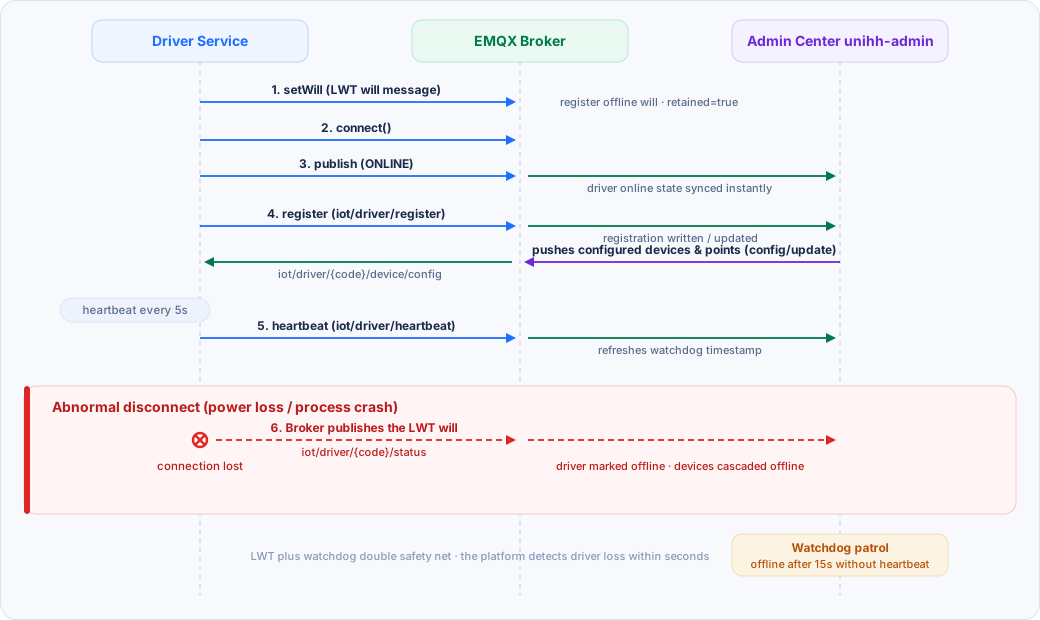
Drivers register themselves on startup and stay alive with a 5-second heartbeat; abnormal disconnects are covered by both the LWT will message and the watchdog.
Key points:
- The admin center senses driver shutdown or crash within seconds, either via LWT or the watchdog;
- The watchdog is the second line of defense: a driver is declared offline after 15 seconds without a heartbeat;
- When a driver goes offline, its devices are cascaded offline to avoid phantom online states.
Acquisition and storage fan-out
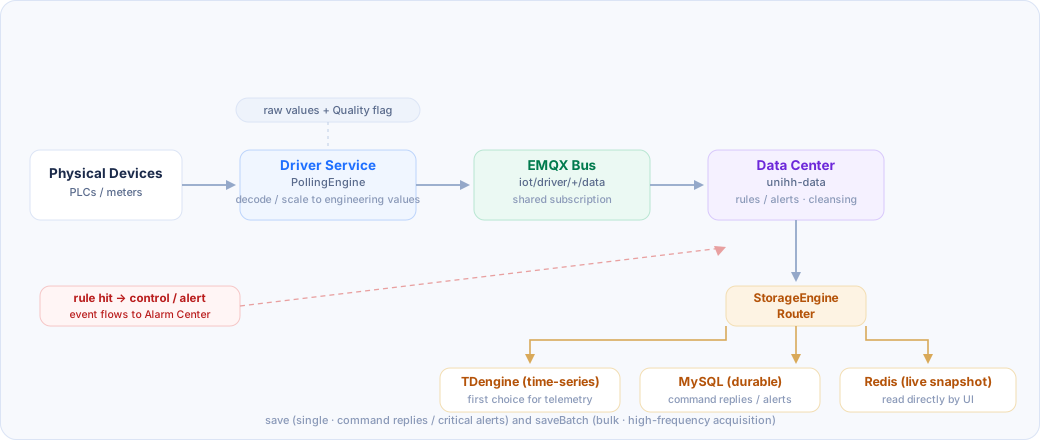
Telemetry enters the data center over the bus, passes rule and alert checks, then lands in storage routed by data shape.
Write-back control chain
Control commands pass gateway auth, then reach the driver over a dedicated MQTT topic and are written inside the channel lock.
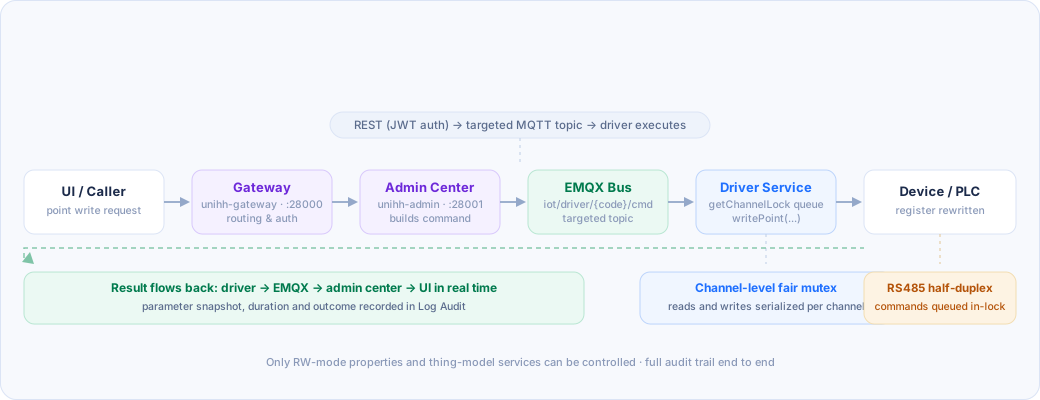
Reads and writes on half-duplex buses (e.g. RS485) are queued through the channel lock automatically — see the Driver Management manual.
MQTT Topics
All driver interactions run over MQTT topics. The complete topic table lives in the MQTT Topic Reference.